Subterranean termite colonies require soil contact for moisture and travel through mud tubes into structural sill plates, floor joists, and stud bays. In historic homes throughout East Nashville, Germantown, and…
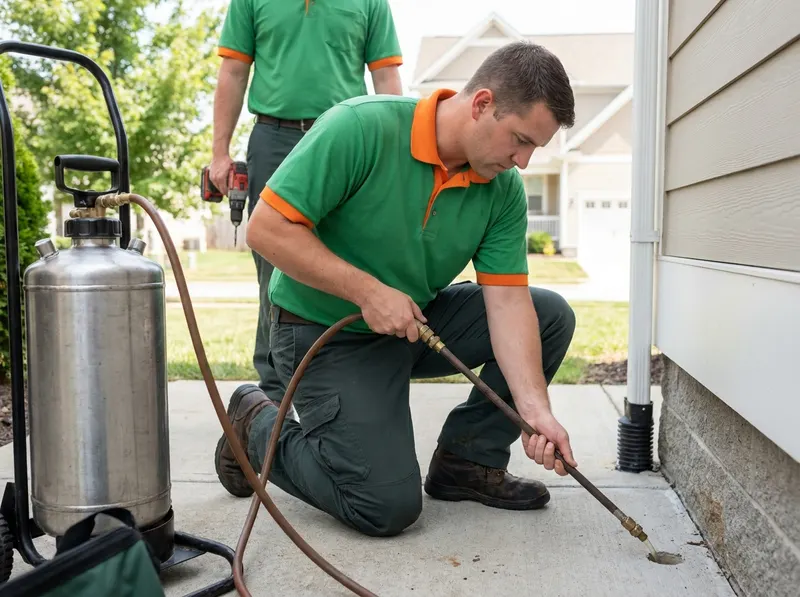
Subterranean termite colonies require soil contact for moisture and travel through mud tubes into structural sill plates, floor joists, and stud bays. In historic homes throughout East Nashville, Germantown, and Belmont-Hillsboro, stacked stone and limestone crawlspace foundations harbor elevated dampness that draws subterranean termites upward. Modern stem-wall or slab builds in The Nations, Sylvan Park, and Green Hills experience infestations through expansion joints and plumbing penetrations hidden beneath utility closets. Surface aerosol sprays fail because they do not reach the subterranean nest located four to eighteen inches below grade. Clinical structural defense relies on continuous termiticide barriers using non-repellent active ingredients such as fipronil at a 0.06% finished dilution, or localized hexaflumuron bait station networks installed every ten to twenty linear feet.
Selecting liquid trench treatment versus exterior bait systems depends on the foundation design and property drainage. Liquid perimeter applications involve excavating a continuous 6-inch by 6-inch trench directly against exterior foundation walls, applying 4 gallons of solution per 10 linear feet per foot of depth. This approach creates an immediate protective zone that foraging termites track back to the subterranean nest, eliminating the primary reproductive queen. The trade-off is surface disruption: liquid barriers require discrete drilling through exterior concrete patios, garage aprons, and brick veneer every 12 inches. Properties bordering Radnor Lake State Park, Shelby Bottoms Greenway, or the steep clay banks of Belle Meade often benefit from non-invasive exterior bait stations when excessive hydrostatic pressure or limestone shelf rock limits continuous liquid trench depth.
Treatments require zero mandatory 12-month auto-billing subscriptions, allowing property managers and homeowners in Inglewood, Donelson, and Crieve Hall to resolve active structural attacks directly. Formulations dry clear, bind tightly to clay soils within two hours, and emit no airborne volatile organic compounds once set, remaining safe for indoor pets and crawling children. Addressing subterranean activity early prevents structural floor sagging and expensive timber sistering near load-bearing exterior walls.
Every job gets a firm, written price after a free on-site visit.
Tell us about your subterranean termite treatment job in Nashville and we'll send a clear, written quote, usually the same day.
 Praxira Pest Experts